Cut the time per client
It was 20+ hours per client per month, plus coordination overhead, to produce one report.
ResultUnder one hour, end to end.I specified, designed and led delivery of a new analytics product that replaced our manual client reporting.
Part of Pandatron's value proposition is to supply transformation leaders with insights and metrics about their transformation programmes. Until this project, insights were produced using unreliable methods prone to hallucinations and inaccuracies. This was a significant burden on our team and a suboptimal experience for our clients.
It was 20+ hours per client per month, plus coordination overhead, to produce one report.
ResultUnder one hour, end to end.Unreliable and hallucinated findings. No data infrastructure for tracking trends over time
ResultAll organisational findings internally traceable to source evidence. New data warehouse for easy insight tracking over time.My primary role was to lead the development of the system as a PM. I also took on significant design and engineering responsibilities, implementing production code including:
Scoped to their organisation's context, it helps them find a new angle, clarify a goal, or surface a blocker. Substantially more valuable to the employee than filling in a survey.
Aggregated and privacy-safe, they become insight into what the workforce is actually experiencing. That second half is what this case study covers.
Where people were using AI, where it was valuable, and what blocked adoption.
Signals from a distributed leadership-development programme.
Workforce experience during a tri-continental merger.
The system analyses employee conversations to show leaders where a transformation programme is getting stuck, which cohorts are thriving, and where interventions are likely to work.
Technically, this meant:
Click any numbered component in the diagram for detail.
Where employees have their conversations. Writes each completed session to MongoDB.
Streams completed sessions from MongoDB into a Postgres database specifically for analytics.
Custom tools for logging observations and answering the client's tracked questions, all model calls routed through our internal LLM gateway.
Code guardrails validate every output before it is stored: e.g. agent referenced quotes are matched against the source transcript, question IDs are validated. Failed checks are handed back to the agent to correct.
An offline evaluation loop that samples stored findings, scores inference and theme quality against a rubric calibrated to human reviewers, and the results feed back into harness improvements.
Every model call from the analysis agents is routed through a centralized internal service rather than hitting a provider directly. It handles provider/model fallback on failure or degradation, so a single provider outage doesn't stop analysis, and lets us swap or A/B different models without touching agent code.
Queries the Postgres analytics database to compute metrics and serve findings to the dashboard, scoped by role so a cohort admin only ever sees their own cohort.
A cohort finding (e.g. “German marketing ICs are held back by X”) is built from user patterns (what seems to be going on for one person), which are built from observations, single things noted in one conversation, which are built from quotes: the employee's own words, taken from a real transcript. Every level traces back to a verbatim quote.
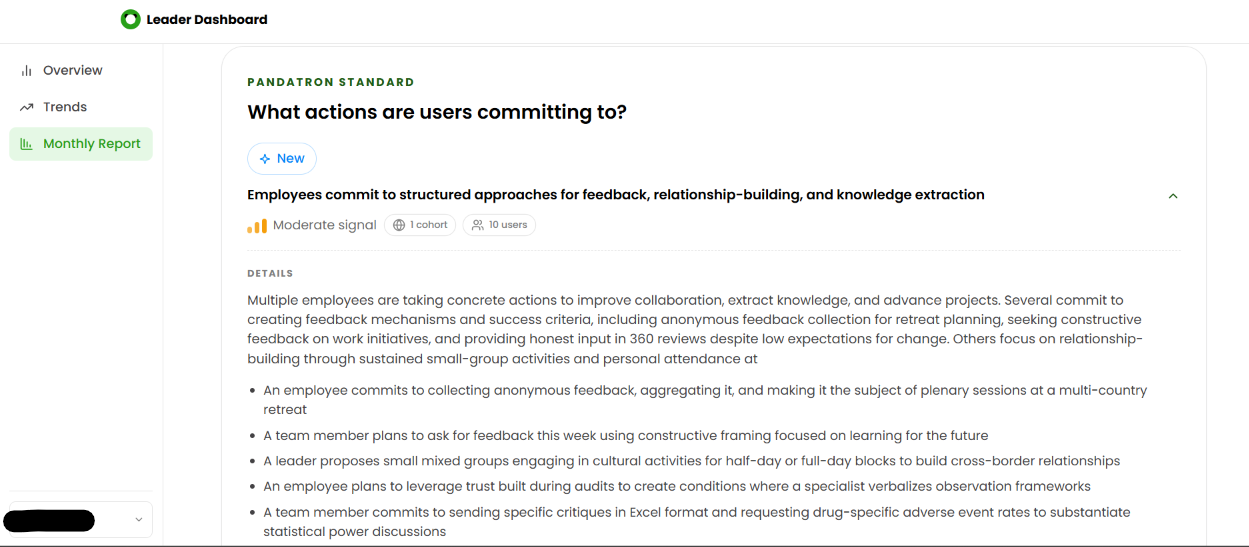
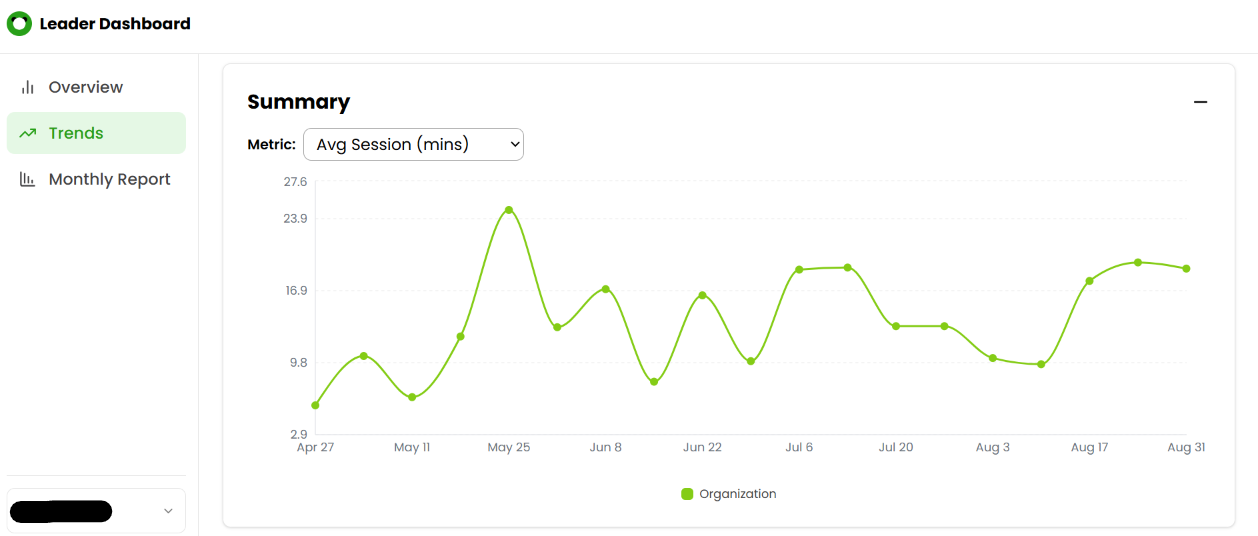
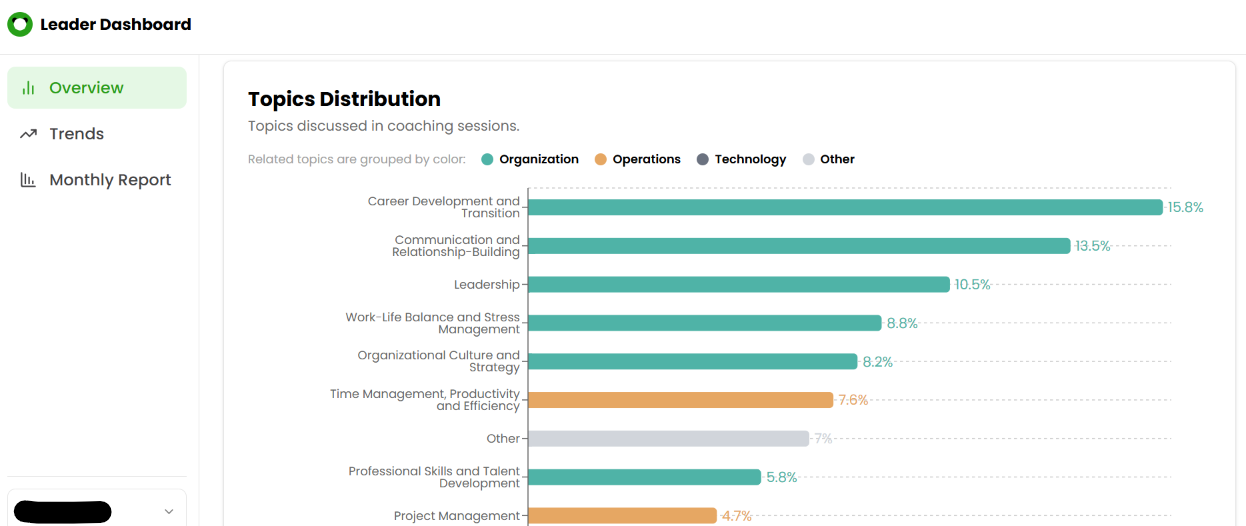
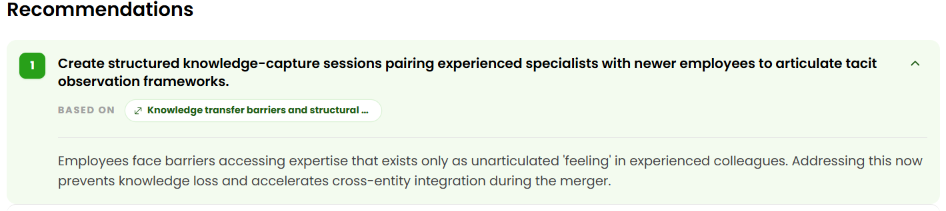
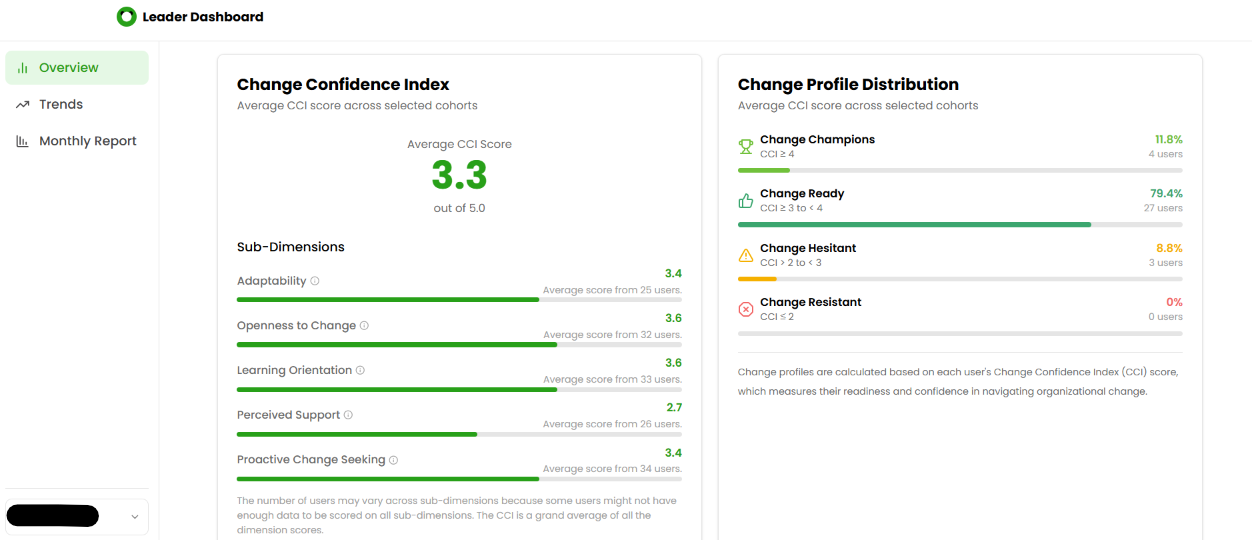
Where client leaders view and track metrics and insights for their programme over time, and configure the questions they want tracked. See examples →
Simplified from the production system. Internal service names and client-specific detail omitted.
Follow the system end to end: from a single conversation to a bounded, evidence-linked organisational finding.
Acme employees use Pandatron to discuss their experience with the transformation. Here, one employee in the German marketing ICs cohort sits down to talk about how the organisation is adopting AI. Leadership's standing question for this programme: “What is hindering effective AI use?”
The observer agent functions as the analytics engine's nervous system. It works continuously in the background, processing each conversation as it completes and recording raw evidence in a consistent schema. The goal is to gather observations for a given question, not yet to analyse.
One conversation can yield many observations. Only evidence in the transcript is recorded.
question_id · AI adoption challenges
observation · Conflicting communications from manager may discourage AI use despite formal encouragement.
supporting_quote · “I feel conflicted. The written communication says we should experiment with AI…”
Hundreds of other employees are in similar AI-adoption conversations right now. Each one being individually processed by the observer.
For each employee, it has access to notes about their previous conversations. It then compares new observations against the previous hypothesis and updates its model of the user accordingly.
AI use feels unsafe when manager behaviour contradicts policy.
The employee cannot see how AI fits their day-to-day workflow.
Visibility to leadership makes experimentation feel personally risky.
You are an analysis agent. Turn evidence into careful, testable claims about this employee.
Generate a new hypothesis, or evaluate whether evidence is accumulating for an existing one.
“The employee experiences a contradiction between formal AI-adoption messaging and manager behaviour, creating hesitation about AI use.”
rationale · The manager-behaviour observation is the direct driver; the workload, unclear-guidelines and time-pressure observations recur across three separate sessions, reinforcing rather than explaining the hesitation.
New hypothesis“The employee is unsure how AI fits their day-to-day workflow.”
new evidence · Tool-access friction and time pressure reinforce a pattern first logged three weeks ago.
Evidence accumulatingAnalyst agents then compare the anonymised employee patterns and generate new hypotheses. Existing findings get updated.
AI experimentation is constrained by unclear workflow guidance and inconsistent local leadership signals.
“Employees are formally encouraged to use AI, but inconsistent middle-management behaviour is contributing to an environment where experimentation still feels discouraged.”
Acme leaders at different scopes can act on the intelligence and track intervention effectiveness.
AI experimentation is constrained by unclear workflow guidance and inconsistent local leadership signals.
Align managers on explicit safe-to-experiment language, then run a role-specific AI workflow pilot.
German and Japanese marketing teams share adoption friction, but the source of friction differs.
Use a shared measurement framework, but tailor interventions: manager alignment in Germany, localised workflow playbooks in Japan. Compare outcomes before scaling either.
A cohort-admin opens their dashboard and sees a bounded, evidence-linked finding, never the raw transcript or a single employee's words in isolation.
Question · What is hindering effective AI use?
Cohort · German marketing ICs
Finding · “Employees are formally encouraged to use AI, but inconsistent middle-management behaviour is contributing to an environment where experimentation still feels discouraged.”
That one employee's conversation never left their own session. What reached leadership is a pattern, backed by evidence, that they can act on.
Note: this is a representative, fictionalised example. The system details have been simplified and details about the user have been modified to ensure privacy.
Sensitive details have been obscured.